A Sea Change in Politics Takes More than One Session [seventh daily dose of Glass Ceiling Breaks – 1998 to 2000]


I knew that getting Parenting Plans enacted would require an extraordinary effort, and would likely be thought of as ahead of its time, destined for a glass ceiling, but I was truly surprised at the ferocity of the opposition.  The organized Family Law Section of the State Bar Association claimed it would increase, not decrease the number of custody battles.  The Chief Family Court Judge from the largest county in the state literally became unglued from his seat while testifying that the bill would cost millions and millions of dollars in increased court costs.  The women’s groups, particularly the advocates for victims of domestic violence, were certain it would lead to more violence.  And the government agency in charge of child support says less, not more, child support would get paid.

The whole story about this hard-fought battle to get Parenting Plans enacted is set-forth in an Appendix to the hard copy of this book.  Suffice to say it did finally become law (slightly modified) and is now universally acclaimed by parents, lawyers and judges.  Pretty quickly I want to speed ahead to the day I had my second-highest-ever jump for joy.   (For my highest-highest leap, read “Can I take your girl for a Spin?”)  But first a little more on the art of politics:

In the 1997-1998 biennial session of the legislature, the Senate refused to even hear my Parenting Plans bill, simply based upon who opposed it, rather than based on any understanding of what the bill actually said.
Starting a sea change

Starting a sea change

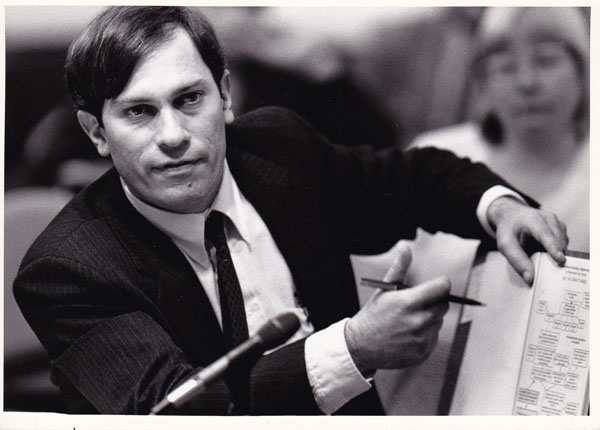
“Okay, you won’t read my bill,” I thought, “Take this Senators!” and I attached my House Bill (with a 110 to 24 vote of my fellow House Members) as an amendment to a Senate Bill going back to the Senate with the court system’s biennial appropriation.  Now the Senate at least had to take my amendment (my Parenting Plans bill) up in a conference committee of House & Senate Members, and, if nothing else, maybe I could leverage its getting jettisoned for something.  And that worked.  The five Conference Committee Senators agreed that if I withdrew my amendment, we would add a one-time appropriation of $75,000 for the Minnesota Supreme Court to conduct a study as to whether I had a good idea or a bad idea.

Miraculously, during the course of the two year study, the mediators and family therapists won out over the lawyers and judges, and, although there was a minority report, the majority of the task force recommended the bill move forward in the best interests of children.  It became law in 2001.  In 2002 I retired from the Legislature and became Director of Saint Paul’s Housing and Neighborhood Improvement Dept.  (Read “Third Time’s The Charm.”)  For the next four years I did not practice law, do any divorce cases, and didn’t get a chance to put the law to work myself – and, much to my dismay – it remained so unpopular with lawyers and judges, it was hardly being used.  Remember, laws do not execute themselves in this world.  For four years, with regards to the judicial system, I felt like an outlier, an outsider, a guy looking in with a glass-ceiling, un-liked by the Powers-That-Be, all based on a reputation (unfair glass ceiling) for being “a father’s rights guy” rather than a champion of children.

Tomorrow:  The Glass Ceiling FINALLY Breaks


Parenting Plans [sixth daily dose of Glass Ceiling Breaks – 1985]


Perhaps the nuts & bolts legislation that did the most to change the status-quo was Parenting Plans.  At its core it was a simple idea:  In a divorce case (or paternity case), no longer would the Judge decide custody, which parent gets the kids, choosing one fit parent over the other.  Rather, the parents themselves (with the help of a mediator if necessary) would draw up a parenting plan detailing the times they each would have the kids.  No more custody labels.  No more winner-take-all.  Child support was separated from custody.  Self-determined divorce.  Kids would no longer be in the middle.  Each parent’s involvement in the future up-bringing of their children would be maximized.

Like many of my ideas, it was based on real-life experience.  In 1985, two years before I got elected, Brad Hipple hired me to be his divorce lawyer.  He told me they had one kid together, a two year-old, and all he wanted was to keep being a Dad.  However, a year ago his wife had convinced him they needed a cooling-off period to save the marriage and got him to move back to his parents’ house, even convincing him to start working overtime to help pay-off bills now that he had nothing better to do.

But Brad had waited too long to see a lawyer.  She was going to win the kid because the kid was only two and had been in her custody for almost half the kid’s life.  He was going to have to pay extra in child support because he had had a year of increased earnings.  Plus I had to tell him, “If you agree to let her have custody, she can move – with the kid – back to her parents’ in Oregon – so you need to start a custody fight regardless whether such a thing would be bad for the kid.”

And so, for the umpteenth time, I start on an unnecessary, expensive, demeaning custody battle asking him, “What are the worst things you can say about Mom?” poisoning the well for any future parental cooperation.  Sure enough, in the end we couldn’t convince Mom to be reasonable, she had such a good hand to play, and the Judge decided, “given the child’s tender years,” to let Mom have custody.  Lo and behold, within the year she and the kid moved to Oregon, and Brad was relegated to only being a visitor a couple times a year.

Grace, my mom, me, El & Lil' Jack at the press conference announcing my retirement - "Going to be the best parents we can be."

Grace, my mom, me, El & Lil’ Jack at the press conference announcing my retirement – “Going to be the best parents we can be.”

Tomorrow:  A sea change in politics takes more than one session.


Minnesota Youth Works [fifth daily dose to Glass Ceiling Breaks – 1993]


Okay, you know it’s true, I was an idealist, an antagonist to the Powers-That-Be, and that was my reputation, my glass ceiling, coming into the 1993 city-wide Mayor’s Race.  But inside my District I was known as a pragmatic “bring home the bacon,” get things accomplished kind of legislator, like urban homesteading, community prosecuting, and the Minnesota Supreme Court Task Force on Racial Bias in the Courts (which led to evening out the State’s criminal penalties for drug offenses and making sure about accurate translating in our court rooms, among other things).

Of the kids, by the kids, for the kids

Of the kids, by the kids, for the kids

At the top of my pragmatic Neighborhoods Agenda was Minnesota Youth Works, the predecessor to Bill Clinton’s Americorps Program.  Clinton wasn’t President yet when a high school kid, after hearing my idea, christened it “Minnesota Youth Works.”  I am particularly proud of this legislation because it was of the kids, by the kids, for the kids, written by the kids, named by the kids, and lobbied by the kids.  What the kids had me write up was based on telling them my experience working for Voyage House at low wages right after college (see “What I did with My College Education”) helping runaways and throw-aways because I didn’t have to worry about getting the kind of job that paid enough to pay-back college loans.  What we ended up drafting was a bill to match the enormous talents and resources of young people to the ever-increasing needs of our troubled communities, to demonstrate the connection between providing opportunities for at-risk youth and reducing crime rates.  My political philosophy has always been:  Equality of Opportunity; Not Necessarily Equality of Outcome.

I gathered together a group of high school and college students from around the State and asked them what Pres. JFK had earlier asked me and my generation:  “Ask not what your country can do for you; ask what you can do for your country.”  Together, me, the kids, and my colleagues proposed and passed a program to provide participants the opportunity to assess community needs and perform community service to meet those unmet needs, in return for a small stipend and a reduced-cost college education.  This is the nuts & bolts kind of thing my District was expecting:  Provide some of our out-of-school, out-of-work, young people with a chance by asking what they’d like to do to better their community and better themselves.  We ended up with a modern day Civilian Conservation Corps of tutors, reading volunteers, tree-planters, youth basketball coaches, after-school dance instructors, senior chore aides, and eventually more college grads.

But getting it passed with a Ten Million Dollar ($10,000,000) start-up fund took some work.   The House Speaker got on board early and designated it House File #2, indicating it was a caucus priority.  My Best Buddy Legislator, another co-author, got his college intern to organize a state-wide, seven city press conference tour, with high school students in every town telling their local media why they wanted their local legislators to vote for the bill.  In part of the press conference I used the JFK quote and described the great injustice of graduating from college with so much debt you couldn’t be what you wanted to be.  Best Buddy Legislator Howard Orenstein then described the huge cost to our State having to build new prisons, and linked passage of our legislation to reduced crime and safer communities.

In the end it was the young people themselves who got the money appropriated.  Their presence was felt throughout the session right down to the last night sitting in the hearing room where the appropriation vote was to take place.  They got the money they wanted. Youth Works was later merged with Clinton’s Americorps Program resulting in thousands of Minnesota college students getting help with their tuition costs, but the injustice of mountainous college debt has not gone away for many middle-class Americans.  A growing number of older Americans are saddled with the loans they co-signed to help their children pay for a college education.  Come on Jack & Nick!  Come on you young guys!  Let’s do something!

Tomorrow:  Parenting Plans


Another Supreme Court Case [fourth daily dose to Glass Ceiling Breaks – 1997]


When the Secretary of State refused to put my name on the ballot as the New Party’s candidate because I was already on the ballot as the Democratic Party candidate, we sued in federal court and won.  The State’s argument was “fusion” would lead to voter confusion:  “Voters might think they could vote twice.”  Our argument was that the United States Constitution included the Freedom to Associate.  If people who wanted to associate together to put a candidate on the ballot were not free to do so, then it violated the Constitution.

“Fusion” is where you are on the ballot on two different party lines and the voters can choose on which line to vote for you  – still having only one vote – but you, the candidate, get the combined total for all voters for you on either line.  In other words, while not violating the “one person, one vote” rule, it’s a way to organize and create excitement about building a NEW political platform, and demonstrate support for the platform by how many votes were for Dawkins on the New Party line compared to the Democrat’s line.  Maybe in time Democrats would be more mindful of New Ideas.  Individuals not particularly enamored with either of the two major parties get more of a voice, more of a chance to be effective – exactly what the Freedom of Association clause was meant to protect, is how our lawyer, known as the “Tenth Justice,” argued it.

Two Harvard Law Profs:  Tribe and Lessig

Two Harvard Law Profs: Tribe and Lessig


You see, winning the law suit didn’t get the Establishment to back-off, and, in the end, fusion hit its own glass ceiling.  I talk about my glass ceiling in “The Third Time’s The Charm,” the ceiling I had when I ran for Mayor.  In either case, by “glass ceiling” I mean the attempt to marginalize an idea (or me) from having greater success, not based on merit (or ability), or the promotion of democracy, but rather by fiat from the Powers-That-Be in order to preserve their power, the status quo.

The State appealed all the way to the United States Supreme Court, and in Timmons vs. Twin Cities Area New Party (Timmons was the stand-in for Minnesota’s Secretary of State), six of the nine Justices held that the State’s interest in an orderly ballot (pretty paternalistic) trumped the Constitutional Right of Free Association, and voted to give favored status to what they called “the traditional two party system.”  (This despite our case being argued by the Harvard Law Professor known as the “Tenth Justice” because of his many appearances before the U.S. Supreme Court on constitutional issues.)  So it’s up to you, the Up and Coming Generation, to crack and break glass ceilings.  Don’t give-up on Politics!  It’s all we have!  Read Republic, Lost.

Tomorrow:  Minnesota Youth Works


Come On Third Parties! [third daily dose to Glass Ceiling Breaks – 1994]

One of my favorite visionary bills that never got a committee hearing was to morph Minnesota into proportional representation, whereby more than one person can get elected to represent a district.  Any candidate who gets at least 10% of the votes in his/her district gets elected.  So, for example, Candidate A gets 55% of the vote, Candidate B 29%, Candidate C 11%, and Candidate D 5%; then only A, B, and C get elected, and A gets 5 votes, B has 3 votes, and C has 1 vote at the Capitol.   I saw it as a way to increase the number of voices that get heard in politics and get more ideas into play.

There are maybe plenty of Minnesotans who believe Third Parties need to be added to the mix, given more of a chance, and don’t like the gridlock rendering the two party system incapable of doing much.  The bill, however, had no chance of passage in the Two Party Controlled Legislature.  Then in 1994 I was given a real chance to do something for Third Parties.  Nineteen-ninety-four was the year after I lost the Mayor’s Race and I was not particularly beholden to the Democratic Phoney Laborers who had supported my mayoral opponent by calling him a genuine Democrat while I was telling the voters that he was most certainly a chameleon dressed-up as a Democrat.  (The guy I’m referring to, by the way, actually did become a turn-coat and join the Republican Party.)   But this wasn’t the reason I said “Yes” when the Twin Cities Area New Party asked if I would be their candidate too, as well as the Democrat’s candidate, on a “fusion” ticket in my ’94 re-election bid.  I said “Yes” because I was the leader of the Democrats in my district who understood the need for change.

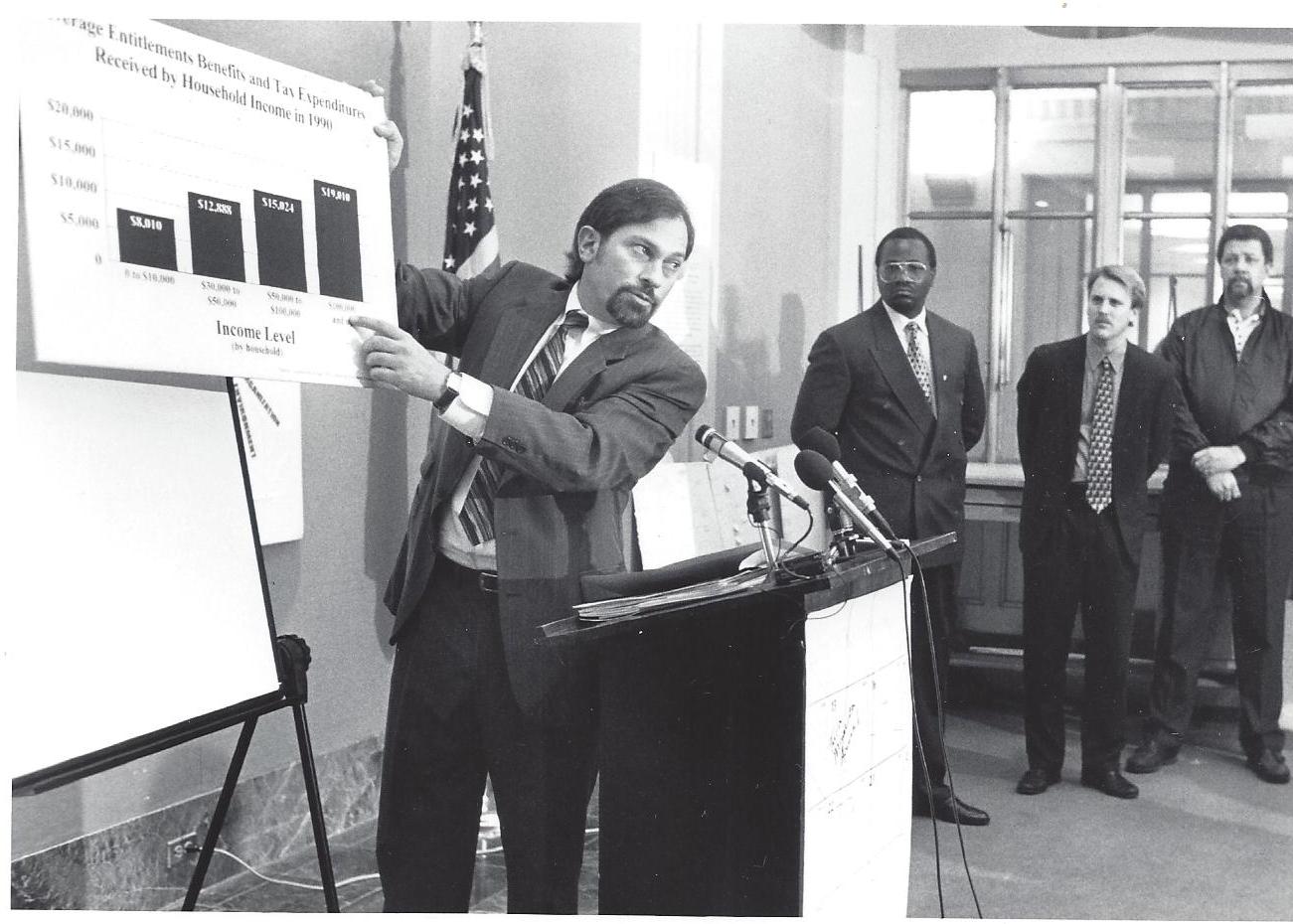
Shem Shakir, Wayne Lundeen, Yusef Mgeni unveiling the Neighborhood's Agenda

Shem Shakir, Wayne Lundeen, Yusef Mgeni unveiling the Neighborhood’s Agenda

My district was a “majority-minority district,” meaning Caucasians are outnumbered, and also one of the poorest in the State.  We always suffered from low voter turn-out.  If Third Parties could organize and have a decent chance, then maybe more people would pay attention to politics.  This is one of the least understood parts of our political system.  People excuse not voting by saying one vote doesn’t matter and/or nothing ever changes.  The truth is that politicians pay more attention to those who vote than those who don’t vote.  The mostly poor folks in my district who were not voting were actually voting to have their pocketbooks fleeced and wallets picked by the Powers-That-Be.  I’ll never forget the time in a caucus meeting of Tax Committee Democrats I was told, “Andy, renters don’t vote; we’re giving the property tax relief money to homeowners.”  The Democrats were not always my District’s best friend.

There is another sad truth about politics that my District understood:  Our District was a “high index district,” meaning we almost always voted heavily for just the Democrats; and the problem (the truth of the matter) is that legislators tend to legislate in favor of districts where the race between the (two only) parties is more competitive.  I was told more than once, “No Dawkins, we’re not putting that money into your district because you’ll get re-elected no matter what (and if not you, then another Democrat); we’re putting the money into a district where our Democrat incumbent needs some re-election help.”  Sad, but true.  Come on Third Parties!  We need some help!   Come on Jack!  Come on Nick!  Come on you Up & Comers!

Tomorrow:  Another Supreme Court Case