The Neighborhood’s Agenda [second daily dose of Glass Ceiling Breaks – 1988]

Getting called “Andy Sandanista” was not the way I wanted things to start-out.  Perhaps if I’d had a quick retort (like I did that time in the Judge’s chambers), and said something like, “Well, if it isn’t the Democratic Phony Labor Caucus,” then I could have cracked my glass ceiling the first day on the job, but I was too earnest to be a smart-aleck back.
Earning an unwelcome sobriquet

Earning an unwelcome sobriquet

My first year at The Capitol, I mostly watched and listened, as told to.  By my second year I had a full slate of bills.  But first, two more stories from that first year:

Around the second week of my first session, a fellow Progressive (we had a Progressive Legislators Caucus) told me, “When in doubt, vote with Willard.”  Rep Willard Munger, who sat right behind me on the House Floor, was the Dean of the Legislature, the Champion of Minnesota’s Lakes and Natural Resources, a man with a Trail named after him stretching from Saint Paul to Duluth.  A couple days after getting that advice, a bill comes up for a floor vote where I’m not sure whether pushing the green button or the red button would be best for most Minnesotans.  So I look up at the Voting Board in front of me to see which way Willard is voting, but he hasn’t voted yet.  Just then there’s this tap on my shoulder and it’s Willard saying “Which way you voting on this one, Dawkins?” To this day I don’t know if Willard was part of an initiation rite of passage or genuinely wasn’t sure which way to vote and respected my opinion.

Around the second month of session, I gave my Maiden Floor Speech, impromptu and unplanned.  I just couldn’t refrain after listening to so much hypocrisy.  The Republicans were actually arguing that a law the court had declared unconstitutional shouldn’t be deleted from our statute books.  The Democrats were arguing that it didn’t make sense to keep something in our law books that people would read thinking it was the law when it wasn’t.  The trouble was that it was all about sex, and even back then the Republicans were behind the times, and extremist about regulating people’s personal lives.  The law (which was no longer the law) said that gas stations couldn’t dispense Prophylactics to combat STDs (among other things).  When I stood up I described how, almost half the Sundays of the year, there are Vikings Cheerleaders parading around on TV scantily clad; everyday merchandisers are legally making money pushing sex to sell their products, and complained that in a society that gives so many mixed messages that sex is tantalizing, wonderful, and verboten, it’s really the height of hypocrisy to argue against a straight-forward message (not even a change in the law) telling kids at least Be Safe.

My second year “Neighborhoods Agenda” was almost all brass tacks, nuts & bolts, concrete ways to help Saint Paul and its neighborhoods.  Many of these bills later became enacted, and some are mentioned in other stories.  In addition to being pragmatic in a nuts & bolts way,  any politician worth their salt, needs to provide leadership painting a vision of what might be someday, if not just yet.   It’s a belief I still strongly hold.  Come on You Future Politicians!  What’s the vision for the future?

Tomorrow:  Come On Third Parties!
How I Got to be a Judge – The Glass Ceiling Finally Breaks [1986 – 2006]


           “Popular candidates like Andy Dawkins sometimes receive

                           national recognition.  Fiorello LaGuardia, Earl Warren,

                           Ronald Reagan, and Franklin Roosevelt are names that

                           come readily to mind as candidates whose reputations and

                           political careers were enhanced because they appeared on 

election ballots as fusion candidates.”

Justice Stevens in Timmons vs. TC New Party 

I arrived my first day at The Capitol as State Rep. Andy Dawkins filled with tremendous hope, optimism, excitement, joy, anticipation.  All my life I’d dreamed the impossible, maybe I could be President of the United States someday.  Now it seemed possible.  Only to be greeted – at the first private meeting of just Democrats (called a “caucus”) – with one of my brand-new colleagues saying, “Well, if it isn’t ‘Andy Sandanista.’” The attempt to marginalize me began the moment I arrived.

The voters in my District elected me in part because I had promised them I would be the hardest working and most progressive legislator at The Capitol, and I had a resume to back that up.  In the years before getting elected I was one of many local peace activists building political pressure to stop “contra aid,” the practice of the U.S. sending supplies to the insurgents fighting to topple the popularly-elected Sandanista (socialist) Government in Nicaragua.  Having now been elected didn’t mean I had to leave my politics at The Capitol Door; it just meant I had to re-focus from national issues to state and local issues.  This was fine with me, and I had a whole batch of ideas for new laws, some thought of by my neighbors themselves, to make St. Paul safer and greater.

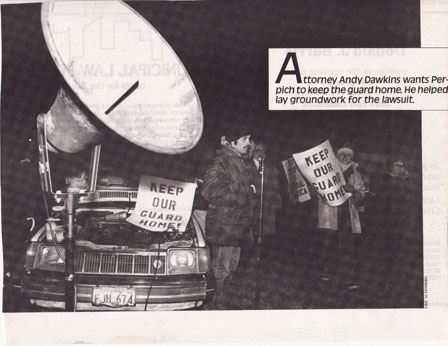
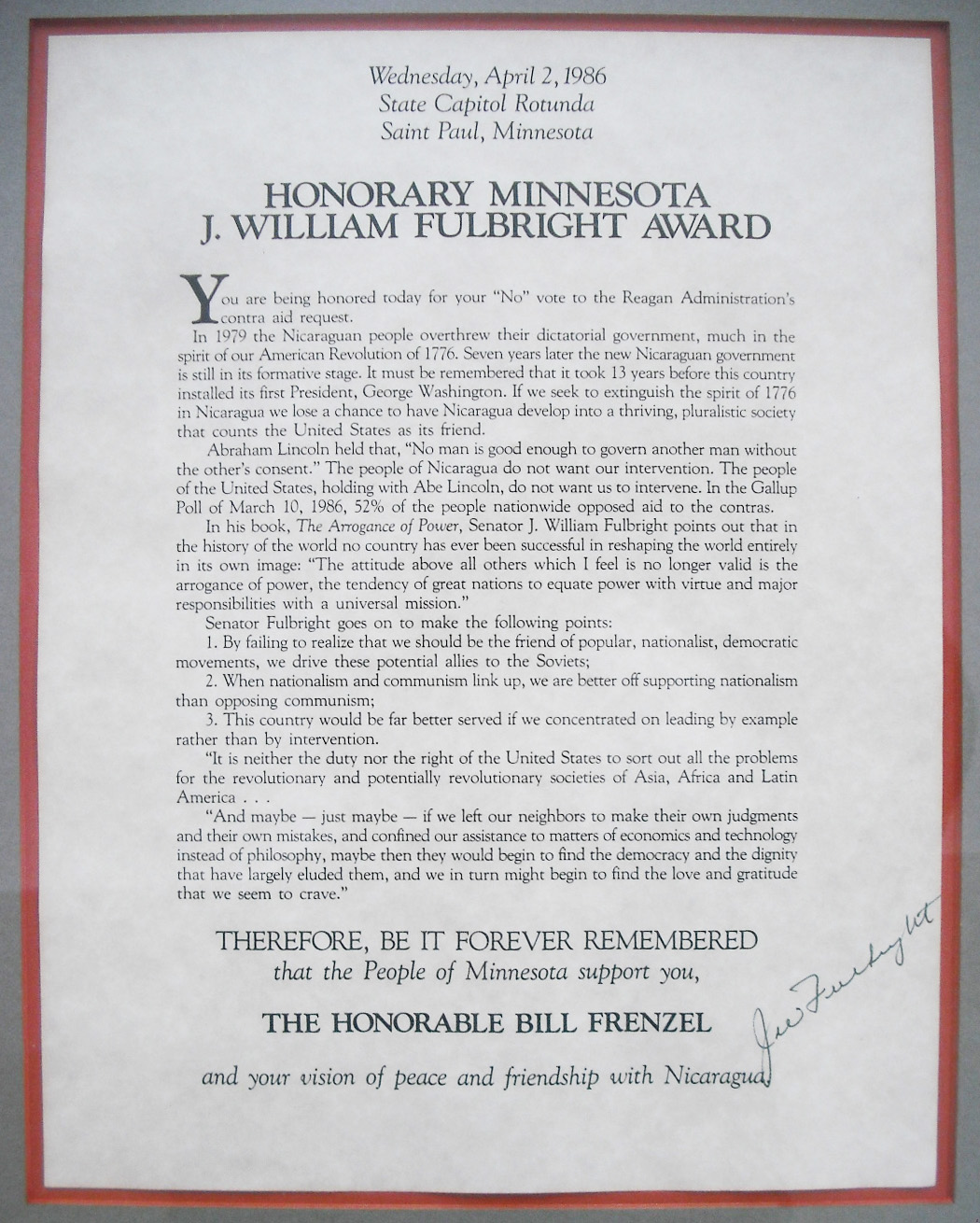
However, in the years before getting elected I’d been in the news more for national politics.  I was prominent in getting then-Gov. Rudy Perpich to sue the U.S. Government arguing that any deployment of the State National Guard had to be made by the Governor, not by the national government, whether for contra aid or otherwise.  I had defended, as their lawyer, a group of sit-in protestors, at then-Sen. Rudy Boschwitz’s office, on charges of trespassing.  Just the year before I’d convinced Sen. J. William Fulbright to personally sign and autograph five letters on parchment paper, each looking like the U.S. Constitution, one each for the five members of the Minnesota Congressional Delegation, praising them for their recent votes against contra aid.

Trade a Kirby Puckett for a Fulbright?

Trade a Kirby Puckett for a Fulbright?

Sen. Fulbright, then retired, was the former Chair of the U.S. Senate Foreign Relations Committee; the man the scholarship program is named for; and author of The Arrogance of Power, a book I’d read in college forcefully arguing that the place for the United States in Central America was with the people, supplying farm aid, infrastructure aid, education aid; rather than supplying military aid to forces fighting the government they had elected. I convinced Sen. Fulbright by telling him I would put the letters under glass, in a gold frame with a red border, and hand them out as Awards in a ceremony to be held at The State Capitol Rotunda.   The Awards Ceremony went great, maybe not quite as much publicity as we would have liked, but 4 of the 5 Congressmen (they were all men then) showed-up to receive their awards – and only one of them changed their vote later – but I got that guy’s Fulbright-signed letter back and it’s on my wall now – Wow!  Not only do I have Nellie Fox and Kirby Puckett signed autographs, I’ve got a J. William Fulbright!

Tomorrow:  The Neighborhood’s Agenda


Inside & Outside Politics [1988]

 Not even a Kennedy could get in

In 1988 I was a one-year-legislator with the now-seemingly-reachable ambition to be President of the United States.    In the “Open Letter” to my kids I say why I still believe to this day that the politics I wear on my sleeve can be mainstream politics, the politics of a majority of Americans.  Although this ambition to be President hit a glass ceiling in 1993 (as described in “Third Time’s The Charm”), in 1988 I was at the pinnacle of success supporting Jesse Jackson for President over Michael Dukakis.  Jesse Jackson mainstream?

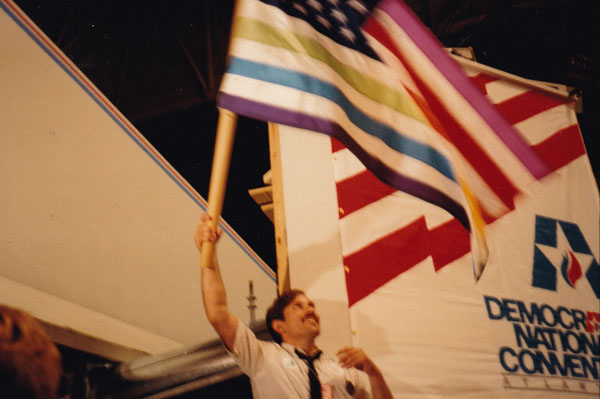
I was elected by a state-wide group of Democrats to be a Jackson Delegate to the Democratic National Convention in Atlanta in 1988.

Waving the Rainbow Flag at the 1988 National Convention

Waving the Rainbow Flag at the 1988 National Convention

To this day I believe that Jesse had more appeal for mainstream America than Dukakis showed in the race against the first George Bush.  In 1968 Jesse was marching in the streets for civil rights with Martin Luther King.  In 1972 I was a protestor in the streets at that year’s Democratic National Convention in Miami Beach.  In 1988 Paul Wellstone was on the plane with me flying to Atlanta, also a Jesse Jackson Delegate.  By 1988 I was elected to serve in the Minnesota Legislature, Jesse Jackson was making a serious run for the Presidency, and two years later Paul Wellstone became a United States Senator.  Before Paul’s plane went down in 2002, he was on his way to becoming President of the United States.

Getting inside the system to change the system is still the best way for the Movement for a New America to succeed.  In 2013 I believe mainstream America is more ready than ever to embrace the protest politics that we all can do better than what we’ve got.  Are you and your family better off now than you were in 1988?  Are you as likely to get a pension upon retirement as I was?  Do the Democrats and the Republicans stand for what’s best for our Country?  Let’s get our current group of protestors into office!

It was a heady experience brushing up against the top echelon of politicians in Atlanta:  Not just the Walter Mondale and Ted Kennedy types, but also the Tom Haydens and Ron Kovics of the world (fellow protestors now inside the system).  Being officially wined and dined and escorted around was fun, but the protestor in me just couldn’t stand seeing the perimeter of the Convention Center walled-off with a ten foot high barbed wire fence and hundreds of protestors on the outside.

On the night Jesse Jackson’s name was put into nomination, I hatched a plan.  Once the entire Minnesota Delegation of Jackson Delegates was seated on the Convention Floor, one-by-one I asked them to give me their credentials (official passes to get through the barbed wire gates), promising I would give them back within the hour.  Got about 40 sets.  Then I left the Convention and found about 40 Homeless Protestors outside, handed out the credentials, and escorted them inside.  We got past security into the Convention Center but at the entrance to the Convention Floor the Fire Marshall said the place was at maximum capacity and not even a Ted Kennedy could get in.  So we retreated to the salon outside the floor where there were big screen TVs of the goings-on, a grand buffet and free cocktails.  I was profusely thanked by the Homeless for the great meal, gathered back all the credentials, and then managed to get back on the Floor myself to cast a vote for Jesse.

P.S.  Paul was my roommate in Atlanta and some of us already had plans afoot for his U.S. Senate run.


Hubert’s Photographer


Hubert’s Photographer

My first years as a legislator I was young enough to hang around with the interns and pages playing Frisbee and softball, and what not, without being thought of as an old fogey.  They gave me confidence that progressive politics was still much in demand.  One of the pages, Carol, shared a story that to this day I’ve never seen written, and it’s interesting enough to share.

Her dad was Hubert H. Humphrey’s photographer for all those many years he was Minnesota’s very popular U.S. Senator.  Part of HHH’s mystique was that he always remembered everybody.  He’d come back to your town, say six years later, and remember your name and what you did for a living – quite a feat amongst so many, many thousands of Minnesotans.  “You know how he did it?” Carol asked me.Buttons Four

“No,” I said, “tell me.”  Well, her dad would take pictures of everybody Hubert met and then ask for their name and address (and occupation) to send them a print later (making a note to himself about what they did).  Then when next Hubert was making an appearance in that vicinity he’d review all the photographs ahead of time so when Hubert would run into somebody he’d met before, her dad would whisper into Hubert’s ear, “Say, this is Joe the barber.”

Pretty smart politics!

My Bill to Let 16 Year-Olds Participate in Politics

My Bill to Let 16 Year-Olds Participate in Politics

The tow company bill, not a big deal; but it’s hard to forgive Arne vetoing a bill that was of, by and for the kids.  Getting young people excited about life, about politics, about how much fun it all can be, has been a big part of my life, as reflected in these stories.  So when a group of teenagers asked me to sponsor a bill that would allow 16 year-olds to vote, I immediately said good idea. cigar smoker Kennedy shirt

Allowing 16 year-olds the vote was, however, not a new idea.  Rep. Phyllis Kahn had been trying to get it passed for years – with no luck.  So we hit upon a middle ground that might garner legislative support:  Allow 16 year-olds to participate in the precinct caucus and party convention process, but keep the voting age at 18.  In Minnesota political parties convene neighborhood caucuses in February/March to start building the party platform and elect delegates who later meet in convention to endorse candidates for office, but state law limits participation to those eligible to vote in November.  Just change that one part, but not the whole thing.

The group of students who came to me with the idea then got a hands-on education in the political process.  They got students all over the state to visit legislators and get promises of support.  They testified in committee hearings about how schools could incorporate the caucus/convention process into the curriculum, how this would lead to more students caring about issues, how it might result in 18-25 year-olds no longer being the least likely to turn out on election day, and over-all make for a better democracy.  They thoroughly rebutted the argument that they didn’t know enough about the issues to be informed participants.   They were in the galley when the votes were taken.  And they got their bill passed.

But we didn’t give enough thought to whether the Governor liked the idea or not, and Arne’s veto took us all by surprise.  Once again there was no veto message.  If I had to guess at a reason I’d say it’s just a Republican thing to believe in voter suppression.