Act 4 – Scene 3: To Stay with Joy or Not

Act Four/Scene Three to A Complex Apology:  To Stay With Joy or Not?

scales of justice
A Dilemma for Justice

SCENE THREE:    For those on our block, judgment calls were also necessary, maybe easier than the Judge’s but devilish nevertheless  The point of departure was:  Who is the real Joy?  Only it got complicated because it turned out the name she used in California was her birth name, and the Minnesotan we knew was an assumed identity taken while she was on the run from the law.  Not even Fred knew Joy was an assumed name, but neither Fred, nor her daughters, nor any of us doubted who the real person was – it was the Joy we knew, and while in prison she legally changed her name to Joy.   Whew……

Easier didn’t mean it was easy.  All of us did much soul-searching because an innocent bystander (a mom) died in the California shooting.  Certainly not an intentional killing, but the law rightly says (as for guilt or innocence) that when you decide to participate in a bank robbery with guns, you are responsible for all unintended consequences as well.  An innocent person is dead because of your actions, and a son is without a mother – permanently – unlike Joy’s daughters where the loss of mom’s presence, though considerable, was only temporary…. temporary, that is, if the family held together during her prison term.  Fred was great; the kids stayed great; the family all held together.  It still amazes how much normalcy Fred was able to maintain for the sake of his kids.

And somehow we all threaded this needle too.  Certainly it was easy to continue to embrace The Doc and his daughters – they were innocent of any wrongdoing.  But how would we embrace Joy upon her return?  It was even alleged she participated in an attempt to blow-up a police car with police officers in it.

The stream of consciousness went like this:

……….“Yah, it was the 70s……

……….. Yah, the police certainly had some blood on their own hands……..

…………….but No, you just don’t go taking the law into your own hands and fight fire with fire,

…………………..unless you’re truly in a revolutionary war……..

….……. .and Yah, you want Joy’s daughters to get their mom (the real Joy) back as soon as possible……..

…………but don’t forget how important the lesson will be for the Darylmple boys to find reason to believe or not believe in our justice system……..

…………and the biggest Whoa!:  someone got killed at Joy’s hands – and the fact that the police had killed her college sweetheart is not enough to justify it.”

The ethicist on our block posed the question:  Does it matter whether we believed her cause was just or not?  Would we still support her if she had been a Nazi collaborator rather than a civil rights activist?  Would none of her positive contributions to our neighborhood matter if she was once a Nazi sympathizer?

For me, the question was not whether her cause was just; the question for the ages is what choices would I have made under similar circumstances?  Would I have been mature enough to understand the ultimate facing of consequences?  Young, idealistic, and with reason to be revengeful.  In any war there are innocent casualties… but shouldn’t this “war” have been fought in the court of public opinion rather than out of the barrel of a gun?  I hope I would have chosen the former, but maybe that only comes with maturity.

Tomorrow:  The Apology
Act 4 – Scene 2: A Dilemma of Conscience

Act Four/Scene Two to A Complex Apology:  A Dilemma of Conscience

SCENE TWO:     Her bail was a cool one million dollars.  For the sake of her daughters, and because everyone is presumed innocent until proven guilty, and especially because we all knew for sure we’d get our money back, we quickly raised the one million.  We had faith that she wouldn’t skip town and forfeit bail, not just because we had known Joy for so long and knew she wasn’t going to run from her family, but also because we had faith in Fred that he and the girls would be staying put.  His word was good enough for us that things were going to work-out.  Later on I heard we set a record for the fastest time in the history of American jurisprudence for raising that much cash, and also learned that much of the million came from other doctors who knew Fred.

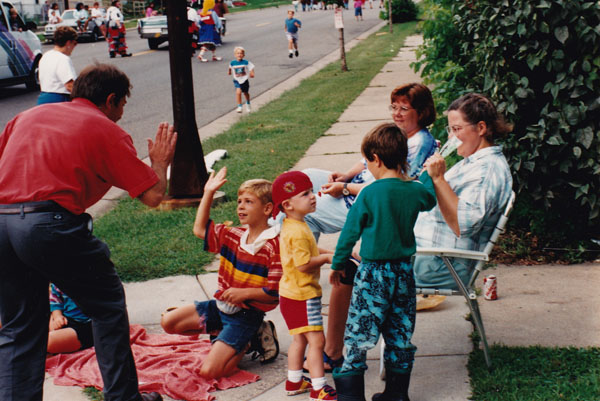
Joy pleaded Not Guilty, and per basic lawyering, kept mum.  For the next year all we learned came from the papers, and those of us on the block marveled at how well the family was handling things.  The girls stayed in school; still kept getting good grades; their friends stayed friends.  The elected politician on our block agreed to appear at her bail hearing as a character witness and made a public statement that he believed in the American justice system, that someone is innocent until proven guilty, that Joy was a long-time friend, that he could under oath tell a judge that Joy was not a flight risk, and that he was sticking by his friend.  The press had a field day speculating this would be the end of the politician’s career, and fellow legislators attacked him for supporting long lost causes, but, in the next parade he was in,

From parading on Bourbon St. to Thomas Av. in 1996
In the Parade

the streets were lined with supporters who said they appreciated how he put friendship above politics.  And that’s kind of the way it was in The Doc’s house too:  This is our mom; we’re going to let the legal system work things out; we’re standing by our mom; we talk to her every day; we hope she gets home as quick as she can.

And that’s how the dilemma of conscience intensified for this one East Como Boulevarder.  Joy was now faced with publicly declaring, even to her daughters, her guilt or innocence, whether what she did was wrong or right, justifiable or not.  She maintained her innocence (at least publicly) up to the time of trial, but the evidence against her was overwhelming.  In the end she agreed to go straight to a sentencing hearing, described her judgment as in keeping with the times, and said she understood that it was up to the judge to pass judgment on what the consequences would be for the judgment calls she had made.  A dilemma for the Judge too.

Tomorrow:  Scene Three

Act 4: The Bad News Is Overwhelming

Act Four to A Complex Apology:  The Bad News is Overwhelming

SCENE ONE:    So now you know how utopian and idyllic things were on East Como Boulevard in the early days of the Summer of 1997 when the Bad News hit like a thunderbolt and spread like wild fire:  “Did you hear Joy was arrested this morning!?”

Everybody knows the rest of the story because it made all the papers and was a lead story on the national news for the next year, but actually, come to think of it, nobody knows the full story.  Of course the first thing most of us thought about was Fred and the girls.  They were all right – or rather as all right as you can be under those circumstances, Fred assured us, saying he had tons of friends and family looking out for him and the girls, that he’d already talked to the girls about what all would be happening, that he had a good lawyer already retained, and that he was standing by Joy.  Later on in a private conversation he told me that before they decided to have kids, Joy told him there was something in her past that could come back to haunt her/them, but that he was better off not knowing anything more.  To which he said, I know the Joy I’m in love with and I’ll face whatever it is with you.

Patty Hearst

Fred’s state of mind helped all of us on the block to not question everything we’ve ever known about Joy.  From the news we learned that Federal Marshalls had taken her into custody on charges of having been part of a violent revolutionary gang involved with robberies, shootings, kidnapping and an attempted police bombing in the California area in the 70s.  Talk about totally unbelievable!  This certainly couldn’t be the Joy we know.  In the end it turned out it was and it wasn’t.

Tomorrow:  Scene Two

Act 3 – Scene 4: Just Before the Bad News Hits

Act Three/Scene Four of A Complex Apology:  Just Before the Bad News Hits

ice skating
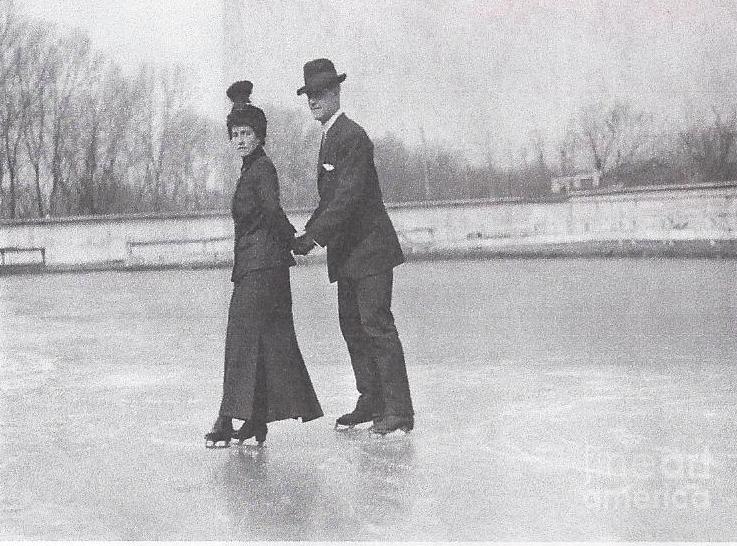
Let’s bring back ice skating on the Lake!

SCENE FOUR:    The kids, of course, soaked it all up, little realizing how lucky they were, how unique their neighborhood was.  Of course you get to ski and toboggan in the winter.  Of course all your friends want to come to your house after school.  Of course your mom makes everybody hot chocolate and cookies.  Of course you can make money shoveling walks and mowing lawns.  So they tackled ice skating.  There’s Como Lake at the end of the block.  Why isn’t it shoveled and made into a rink?  Didn’t there used to be an oval with a warming house that sent speed skaters to the Olympics?  As a group, the kids drew up a petition asking the City to once again get ice skating back on Como Lake, and so it came to be.

By the time they were in high school, a whole set of loosely organized summer activities had also evolved.  Another little used garage on the block became an activities center with a nok-hockey board, a foosball table, and outside a basketball court and volleyball net.  Summertime  the yard was a croquet court that never came down.  The eldest Darylmple boy invented a game called “Guerilla” (which the younger kids thought was spelled G-O-R-I-L-L-A), a sophisticated game of hide-and-go-seek.  One person is it.  The others go hide – using half the neighborhood.  Each hider has six bullets for ammo.  Point your finger and say “Bang!” once, and the seeker has to stop in his/her tracks and count to 25.  Use all your ammo and the seeker has to count to 150.  If you wanted to find a new hiding place, you might use all your ammo at once; if you just wanted to get a head-start on racing away, you might just use 1 bullet and save your ammo.

A kid from the next block over taught everyone how to play “Rip Ball” off the garage roof.  Using the volleyball, the idea is to keep the ball coming off the front of the roof, next in turn batting it up again, until someone misses and gains a strike.  Five strikes and you’re out.  The experts could leap high and rip the ball off the roof requiring the next in turn to have to make a volleyball-like save to get it back on the roof.  Another kid invented a neighborhood version of Frisbee golf, using the Bigelow’s big oak tree, the stop sign at the corner, the park bench, etc., as the holes which your Frisbee had to hit.  Occasionally even a “half-ball” game would spring-up in the alley.  Como Pool was only a short bike ride away.

The beauty of it was that all the kids were outdoors playing, older kids mixed with younger kids, and so it came that the kids still in child care complained bitterly that they didn’t want to go to child care anymore and instead just wanted to have fun in the neighborhood.  Upon learning this, Joy suggested to those parents that if they left a little lunch money, she’d make sure their kid got lunch, assign the most responsible teenagers to make sure the kids stayed safe, and pay the older ones.  Jobs for kids and savings for parents.  What a ‘Win-Win,” soon to be an Americorps Program.  Maybe your kid will be the next Olympic champion speed skater, or get a volleyball scholarship to Santa Cruz State, or be the next great drummer in a rock & roll band.  (A neighborhood band had formed using the Darymple’s grandmother apartment  for jam sessions.)

Tomorrow:  Act Four

Act 3 – Scene 3: The Neighborhood Bank

Act 3 – Scene 3: The Neighborhood Bank

Act Three/Scene Three of A Complex Apology:  The Neighborhood Bank

SCENE THREE:    The idea for a “neighborhood bank” came about incrementally.  After a couple neighbors started borrowing Joy’s electric lawn mower, the block club made a decision to purchase as a neighborhood four electric lawn mowers so everyone could quit using their gas mowers.  The money raised from selling off the old mowers was donated to The American Federation for the Blind.  Mr. Hartwell – now the oldest person on the block after the passing of Mr. Henderson – no longer used his garage and volunteered to store the four new mowers in return for one of the neighborhood kids mowing his lawn.  Eventually the block club saw the advantage of sharing other things besides lawn mowers, and reduced their per capita expenses, by purchasing together (and storing in the Hartwell garage) a power saw, a long extension ladder, two snow rakes, and so on, for everyone’s use.

The next big idea was buying a very large freezer that took up one whole side of Hartwell’s garage, and buying meat and other groceries in bulk from a CSA in Wisconsin.  CSA stands for Community Supported Agriculture – organic farmers who take orders early in the year, grow or raise what’s ordered, and then make regular deliveries throughout the year.  Not only did those who joined save money, they also saved time on less trips to the grocery store.  Best of all, they found that free-range chickens tasted better!  (And tomatoes didn’t have to be hard as rocks.)  Meanwhile, a community garden sprung-up, and within a couple years, the neighborhood was growing its own tomatoes rather than buying them from the CSA.

Americorps

The tough part was keeping track of who grew the tomatoes, who wanted tomatoes, who ordered the beef and who didn’t, and who mowed whose lawn, etc.  This led to the establishment of “the neighborhood bank” which started simply as a sign-in / sign-out sheet in the Hartwell garage, then became a ledger book where you could note “credits” for your contributions and your “debits” as you advantaged the free lawn mowing, etc.  All of which led to a part-time job (earning credits) for Joy who oversaw the after-school recreation program and collected real money from the parents whose kids no longer went to child care (and now, instead, were in the rec program). 

“The bank” disbursed money to the teenagers who ran the rec activities (and/or were mowing lawns, etc.), and there was a monthly accounting of who still had credits coming for some future services.  At the time the Bad News arrived, the block club had just begun a tithing program from the per capita savings and was seriously exploring expanding “the bank” into a self-insurance line and a “crowd-sourced” loan outfit.  Solar roof collectors were on the list of things to buy that save money.  Of course, little of this would have been possible without everyone having total faith in Joy and total trust in her honesty.  (Actually none of this would have been possible except that Fred the Doctor made good money and Joy could be a stay-at-home mom.)  Harmony in all ways.

Tomorrow:  Scene Four